.webp)


Facing an August AC Breakdown: Is It Worth Fixing?
Is your system struggling to keep up, leaving you wondering about repairing vs. riding out the summer: what to do when an aging AC struggles in August? When the August late-summer heat hits its peak, an air conditioner breakdown is more than just a minor inconvenience—it is a major disruption to your daily life. You are immediately faced with a frustrating dilemma: do you pay for a quick patch to survive the rest of the season, or is it time to invest in a full system replacement right now?
Making the right choice depends heavily on your system's age, its current condition, and the specific demands of our local climate. Rushing into a decision without considering these factors can lead to wasted money on temporary fixes or premature replacements. To navigate this decision clearly, you need an objective evaluation of your equipment to weigh these options. If you need to evaluate your options, our team provides professional HVAC services to help you schedule an honest AC evaluation.
The Mid-Summer Decision Point
The urgency of the situation: When the temperature inside your home starts climbing toward 80 degrees, panic naturally sets in. The immediate goal is simply to get cold air flowing again. However, treating a symptom without understanding the underlying cause is a risky approach for aging equipment.
Many homeowners assume that because summer is winding down, they just need the system to limp along for a few more weeks. But a struggling air conditioner is often communicating a much larger systemic issue. A compressor that sounds louder than usual, airflow that feels weak, or a unit that runs continuously without reaching the set temperature are all signs of severe mechanical fatigue. Addressing these symptoms requires looking beyond the immediate discomfort and evaluating the overall trajectory of your cooling system.
The True Toll of Late-Summer Heat on Aging Systems
To make an informed decision, it is critical to understand the concept of cumulative wear-and-tear. By the time August arrives, components like run capacitors, blower motors, and compressors have been operating at maximum capacity for months. They have endured thousands of start-and-stop cycles, fought through peak afternoon temperatures, and managed heavy humidity loads. By late summer, the equipment is physically fatigued, making it highly susceptible to sudden failures.
In Placerville and the surrounding Sierra foothills, the cooling season does not magically end on September 1st. The intense, dry heat often persists well into the fall, meaning a "temporary" patch applied in August must still endure weeks of extreme workload. This environment acts as a relentless stress test that exposes the hidden weaknesses in aging equipment, increasing the risk of a secondary failure shortly after a repair is completed.
Why the "Temporary Fix" is a Stress Test
A typical pattern we see involves systems buckling under extreme temperature spikes. For example, during stretches of 109-degree weather, an overworked unit might simply stop functioning altogether as safety switches trip or tired components finally give out. While a fast response can get the system back online and provide immediate relief from the heat, that initial failure is often a symptom of deeper component degradation.
• Capacitor degradation: These small electrical components store the energy needed to start your motors. After months of intense heat, they lose their ability to hold a charge, eventually failing and preventing the system from turning on.
• Motor fatigue: Blower and fan motors work overtime to push air through your home. As bearings wear down and dust accumulates, they run hotter and less efficiently, eventually burning out under the late-summer strain.
• Compressor strain: The heart of your air conditioner works hardest when the temperature differential between inside and outside is highest. An aging compressor struggling in August is often on borrowed time.
When a Quick Repair is the Right Call
Not every breakdown requires a massive overhaul. There are clear, objective criteria for when a band-aid or component repair makes the most sense. If your system is generally well-maintained and has not yet reached the end of its expected lifespan, a targeted fix can restore comfort quickly and reliably.
Fast response times are critical for restoring emergency cooling during extreme temperature spikes. When outside temperatures soar over 100 degrees, a system might stop cooling simply due to a bad valve or a minor refrigerant leak. In these scenarios, a qualified technician can diagnose the leak, replace the faulty valve, and restore cooling by noon. These types of isolated mechanical issues do not necessarily indicate systemic failure.
Pros and Cons of a Late-Summer Patch
If the system's baseline efficiency is still acceptable, a targeted fix is often the most logical path forward. Here is a breakdown of when repairing is the right move:
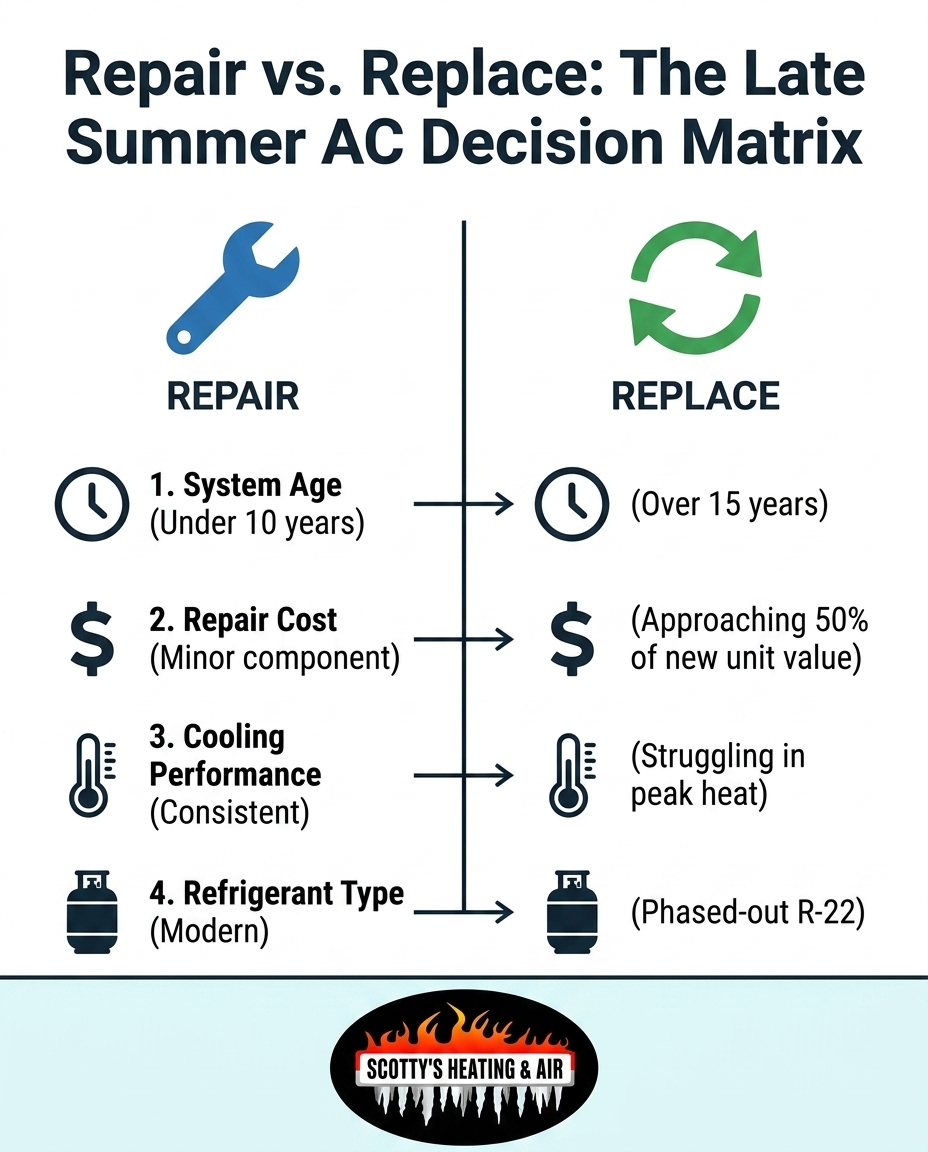
• The system is under 10 years old: Modern units are built to last, and a failure in the first decade is usually an isolated component issue rather than a sign of total system decline.
• Consistent maintenance history: If you have faithfully scheduled annual tune-ups, the internal components are likely clean and well-lubricated, making a repair a safe investment.
• Minor electrical failures: Blown fuses, tripped breakers, or failed contactors are inexpensive fixes that instantly restore full functionality without risking future reliability.
• Acceptable energy bills: If your cooling costs have remained relatively stable over the past few seasons, the core efficiency of the unit is still intact.
Signs It Is Time to Replace Your AC
While a repair is often the easiest immediate choice, there are distinct indicators that suggest replacement is the more prudent, cost-effective long-term decision. Air conditioners typically have a lifespan of 15 to 20 years. However, the demanding climate of Placerville and the surrounding Sierra foothills often accelerates wear, shortening this window significantly. If your unit is approaching this age bracket, sinking resources into a major repair is rarely a wise investment.
One of the most reliable frameworks for making this decision is the "50% rule." Conceptually, if the cost of repairing your current unit approaches half the value of a brand-new system, replacement is the smarter financial move. Investing heavily in a deteriorating machine only delays the inevitable and leaves you vulnerable to further breakdowns.
Red Flags That a Repair Won't Hold
Beyond the age of the equipment, there are several compounding factors that signal it is time to move on from your current unit. If you are noticing signs it's time to replace your HVAC system, ignoring them will only lead to more frustration.
• Frequent, compounding breakdowns: If you have already called for service two or three times this cooling season, the system is entering a cycle of cascading failures. Fixing one part simply puts pressure on the next weakest link.
• Phase-out of older refrigerants: Systems manufactured before 2010 likely use R-22 refrigerant. Because this chemical is no longer produced, servicing these older systems is becoming increasingly impractical and expensive.
• Diminishing cooling capacity: If the unit runs constantly but can no longer lower the indoor temperature to your thermostat setting, the compressor is likely failing.
• Excessive indoor humidity: An air conditioner's secondary job is removing moisture from the air. When an aging system loses its cooling capacity, it also loses its dehumidification power, leaving your home feeling sticky and uncomfortable.
Side-by-Side: Repairing vs. Replacing in Late Summer
To help you weigh your options quickly, it helps to look at a direct comparison between patching an older unit and upgrading to a new system. The decision often comes down to balancing immediate relief against long-term peace of mind.
When you choose a repair, you are prioritizing upfront action. You get the system running again quickly, but you accept the lingering risk of a mid-September failure. When you choose replacement, you are prioritizing guaranteed end-of-season comfort and securing your home's climate control for the next decade or more.
Breaking Down the Long-Term Impact
• Reliability — Patching an Aging Unit: High risk of secondary component failure during September heatwaves. — Full System Replacement: Guaranteed performance and comfort through the end of the season and beyond.
• Energy Consumption — Patching an Aging Unit: Continues to operate at diminished, aging efficiency levels. — Full System Replacement: Drastically reduces energy usage with modern, high-efficiency technology.
• Warranty Protection — Patching an Aging Unit: Only the specific replaced part is covered; the rest of the unit remains unprotected. — Full System Replacement: Comprehensive manufacturer warranty covers all major components for years.
• Refrigerant Status — Patching an Aging Unit: May rely on phased-out, increasingly scarce R-22 refrigerant. — Full System Replacement: Utilizes modern, environmentally friendly, and readily available refrigerants.
Weighing Efficiency Gains and Energy Incentives
If you are leaning toward replacement, it is important to factor in the financial and performance upsides of upgrading to a modern system. HVAC technology has advanced significantly over the last decade. Upgrading to a modern, high-efficiency AC or heat pump reduces cooling energy usage dramatically, meaning the new system essentially begins paying you back immediately through lower monthly utility bills.
Furthermore, newer systems handle extreme temperature peaks much more effectively than older models. Features like variable-speed compressors allow the unit to adjust its cooling output precisely to the demands of the home, rather than simply blasting on and off at full capacity. This results in more even temperatures, better humidity control, and less strain on the equipment during the hottest parts of the day.
How Modern Systems Handle Extreme Heat
The financial offsets of upgrading: When considering a replacement, you should also explore available energy incentives. Generic federal tax credits and local utility rebates may apply to qualifying high-efficiency installations. While these programs change frequently, they are designed to encourage homeowners to adopt greener technology.
We always advise readers to consider these incentives as a factor that can help offset the initial investment of a new system. By combining the monthly energy savings with available rebates and tax credits, the long-term financial picture of a replacement often looks much more appealing than continually sinking funds into a deteriorating unit.
Getting an Honest Assessment Without the High-Pressure Sales
Late-summer breakdowns can make homeowners feel vulnerable. When your house is sweltering in the August heat, it is easy to fall victim to fear-based selling tactics from contractors who insist you must replace the system immediately. This high-pressure environment is exactly why working with a technician who provides a calm, objective evaluation is so critical.
At Scotty's Heating & Air, our commitment to honest, reliable local expertise means we prioritize your long-term comfort and financial well-being over a quick sale. We believe in providing you with clear choices—detailing exactly what a repair entails versus what a replacement offers—so you can make the decision that best fits your household.
The Value of Objective HVAC Advice
Even when an unusual AC problem is diagnosed, a reliable professional will handle the situation quickly and transparently. A trustworthy technician will explain the exact root cause of the failure rather than using the complexity of the issue to force an unwanted upgrade. You deserve an assessment that lays out the facts, the condition of your equipment, and the realities of the local climate, allowing you to choose your path forward without feeling pressured.
Whether the right answer is a targeted patch to get you through the fall or a comprehensive system upgrade, having an objective expert in your corner ensures that your investment is protected and your home remains comfortable.
Frequently Asked Questions
Should I repair or replace my AC in the summer?
The best choice depends on the age and condition of your system. If your AC is under 10 years old and the repair is minor, fixing it is usually the right call. However, if the unit is aging and facing a major breakdown, replacing it ensures you won't face another failure during the hottest weeks of the year.
How do I know if my AC is worth fixing?
A good rule of thumb is to evaluate the repair cost against the age of the unit. If the system has been well-maintained and the repair cost is low, it is worth fixing. If the system requires frequent repairs or the cost approaches half the value of a new unit, replacement is a smarter investment.
Is it worth repairing a 15-year-old AC?
Generally, repairing a 15-year-old air conditioner is a risky financial decision. At this age, the system has likely reached the end of its functional lifespan, and internal components are highly fatigued. Investing in a new, high-efficiency system provides better reliability and lower energy costs.
How long do air conditioners last in hot climates?
While average air conditioners are rated for 15 to 20 years, intense regional heat can shorten this lifespan. Systems operating in hot, dry climates often experience accelerated wear on compressors and motors, meaning they may need replacement closer to the 12 to 15-year mark.
Should I replace my AC before it completely fails in the heat?
Yes, proactive replacement is almost always less stressful than waiting for a total breakdown. Replacing a struggling unit before it fails allows you to carefully research options, secure energy rebates, and schedule the installation at your convenience rather than scrambling during a heatwave.
What are the risks of waiting until next spring to replace my AC?
Waiting until spring means you are gambling that your current patch will hold through the remaining hot weeks of late summer and early fall. If the system fails again in September, you will be forced to make an emergency replacement decision anyway, having already wasted money on the initial repair.
Making the Right Call for Your Home's Comfort
Deciding between repairing vs. riding out the summer: what to do when an aging AC struggles in August comes down to balancing immediate relief with long-term reliability. You don't have to make this choice alone. Reach out to our team to schedule an honest AC evaluation and get the clear, pressure-free guidance you need to keep your home comfortable for years to come.
Customer Testimonials
Hear what our Placerville customers are saying about their experience with Scotty’s Heating & Air.

Great company, great guys, and great equipment! We couldn't be happier with our new HVAC system. It works amazingly well ice cold AC and it is super efficient too. I use these guys for my business and my own house and I would even send them to my grandma's house too. Scott and Tim are rockstars thank you again for helping me out!
We had Scotty’s come out to do a tune-up of our gas heater. The technician adjusted it to burn less gas and protect the longevity of the burner, which we appreciate. The price was reasonable, and we joined their priority services membership.
I called Scotty’s on a Monday to say my system was not working and they were there first thing the next morning to fix my system. Tim was the tech and he did an excellent job. He explained everything he did and my system was up and running again within an hour all for a very reasonable price.
Hottest day so far if the year and my AC stopped working. I called and Scotty called me back within 15 minutes and sent Tim to arrive within an hour. Tim was great, friendly, professional and fixed it quick. I’m so appreciative of their great and fast service!
I absolutely had the best experience! Called at 8am, someone was here by 9:30am and quickly found the problem, he had the part I needed on his service truck and it was replaced and my AC was back up and running in less than 15 minutes! I will be using them again for all my AC/Heating needs!


