.webp)


When the Temperature Drops: Facing a Sudden Heat Pump Failure
At Scotty's Heating & Air, we know that as the September early fall transition arrives, you might find yourself needing to know exactly how we diagnose sudden evening heat pump failures without high-pressure sales tactics when your system suddenly starts blowing cold air. The season is officially shifting, meaning those comfortably warm afternoons can quickly turn into crisp, deeply chilly nights. You go to bump up the thermostat as the sun goes down, but instead of the comforting rush of warm air, your vents remain quiet—or worse, they blow unheated air into an already cooling room.
The sudden discomfort of a heating system failing right when you need it most is stressful enough on its own. However, for many homeowners we speak with, the real hesitation in calling for emergency service isn't just the mechanical breakdown itself. It is the very real fear of being pressured into buying a completely new system on the spot. Calling a technician late at night often feels like a vulnerable position, and no one wants to navigate a predatory sales pitch while their family is shivering.
Here is the thing: a late-night service call should always be about restoring your comfort, not meeting a monthly sales quota. Our team's core philosophy centers on separating immediate mechanical triage from long-term system replacement discussions. When your heat pump stops working after hours, our primary focus is on fixing the immediate problem so you can sleep comfortably, leaving any larger conversations about the lifespan of your unit for the light of day.
The Unique Strain of the Early Fall Transition
To understand why your system might suddenly quit, it helps to look at the specific mechanical shift a heat pump undergoes during this time of year. Unlike a standard air conditioner that sits dormant all winter, a heat pump works year-round. For months, it has been steadily pulling heat out of your home to keep you cool. When the season changes, a critical internal component has to physically shift positions to reverse the flow of refrigerant, allowing the system to absorb ambient heat from outside and bring it indoors.
This transition is particularly demanding in areas with rapid diurnal temperature variation. In our years serving the Placerville foothills, our technicians have seen firsthand how a warm afternoon can very quickly drop into a crisp, chilly evening due to rapid radiational cooling. This sudden plunge in outdoor temperature creates an immediate, urgent demand for heat inside your home. Your heat pump is suddenly asked to switch modes and operate at full capacity after months of doing the exact opposite.
Why Systems Struggle With the Shift
Our experience shows that this sudden demand places a unique strain on older or unmaintained components. The mechanical parts that govern the switch from cooling to heating can become stuck, or the electrical components that handle the sudden surge in power requirements can fail under the new load.
If your system fails to produce heat during this first major temperature drop, do not panic. A failure during this specific transition period is incredibly common. More importantly, it often traces back to a single, specific component issue—like a stuck valve or a blown capacitor—rather than a catastrophic, total system failure. Knowing this can provide immense peace of mind while you wait for a Scotty's Heating & Air technician to arrive.
What Happens During Our No-Pressure Evening Diagnostic
One local homeowner reached out to us during a recent fall cold snap when their heat pump stopped working unexpectedly. They needed their heating back online right away and were wary of being upsold. A Scotty's Heating & Air technician arrived quickly, diagnosed the specific electrical issue without a sales pitch, and repaired the unit on the spot, getting their heat running again very quickly. That is exactly how an emergency diagnostic process should work.
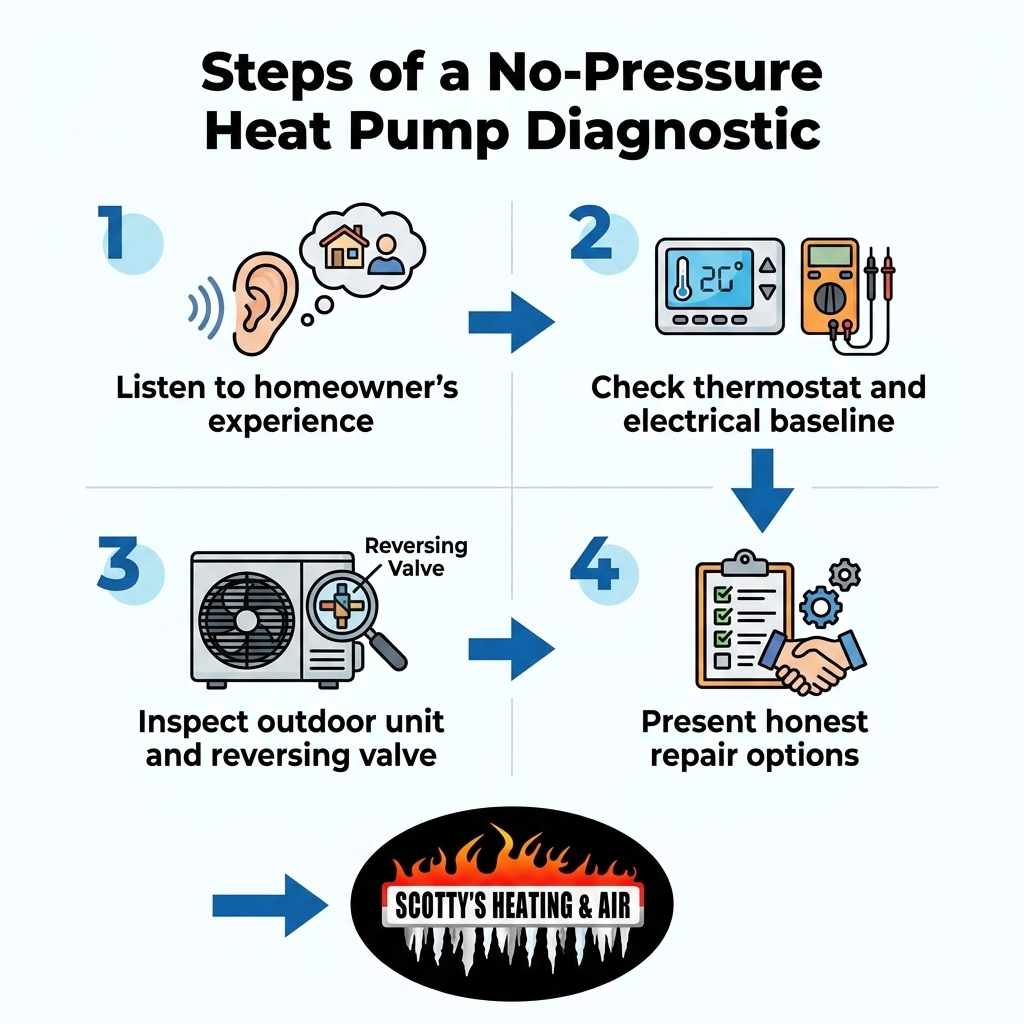
When our technician arrives at your home, their primary goal is restoring heat and comfort for the night, not evaluating your home for a brand-new system. We follow a transparent, step-by-step diagnostic process to isolate the exact cause of the failure.
1. Listening to your experience: We start by hearing exactly what you noticed. Did the system make a strange noise? Did the air slowly get cooler, or did it stop abruptly? Your real-world observations give us the first vital clues.
2. Checking the thermostat and electrical baseline: We verify the power at the source. This means checking breakers, electrical disconnects, and thermostat communication signals. Many "failed" heat pumps are actually just suffering from a tripped breaker or a dead thermostat battery.
3. Inspecting the outdoor unit: We move to the heavy lifting. The technician will check the mechanical operation of the compressor, inspect the reversing valve's status, and verify that all defrost sensors are calibrated correctly.
4. Presenting honest findings: Once we isolate the failing component, we present our findings clearly. We explain exactly what broke, what it takes to fix it, and how quickly we can get the heat back on—without using scare tactics.
Common Culprits Behind Sudden Heating Interruptions
While every breakdown is slightly different, our team typically sees the majority of early fall heating failures trace back to a handful of common mechanical culprits. One Placerville homeowner reached out to us recently when their 20+ year old HVAC system began struggling, leaving one bedroom with inadequate heating. Because the house required separate systems for upstairs and downstairs, we evaluated the specific problem areas first. While that particular situation ultimately required new systems to resolve the coverage issues permanently, the process started with a thorough, honest diagnostic of the existing equipment to rule out simple component failures first.
If you want to understand what might be happening with your system, you can troubleshoot your heat pump by looking for a few specific symptoms. However, it is critical to remember that actual repairs require professional diagnostic tools. Never attempt a DIY repair on a heat pump, as you are dealing with high-voltage electricity and highly pressurized refrigerant.
The Most Frequent Mechanical Failures
• The Reversing Valve — Common Symptoms: System blows cold air while set to "Heat" — Why It Fails: The physical slide mechanism gets stuck after sitting in cooling mode all summer.
• Start-up Capacitors — Common Symptoms: System hums but the fan or compressor won't start — Why It Fails: Electrical fatigue causes the capacitor to lose its ability to store and release the energy needed to start the motors.
• Defrost Sensors — Common Symptoms: Outdoor unit freezes over entirely in cold weather — Why It Fails: The sensor fails to read the outdoor temperature correctly, preventing the system from melting normal frost buildup.
• Contactors — Common Symptoms: System won't turn on at all, or won't turn off — Why It Fails: The electrical switch gets pitted or burned from continuous use, breaking the electrical connection.
The reversing valve is arguably the most common culprit during the seasonal transition. Because it handles the physical rerouting of the refrigerant, a small amount of internal wear or electrical failure at the solenoid can leave it stuck in the cooling position. Our professionals test this by checking the electrical voltage at the valve and measuring the temperature differential on the refrigerant lines to confirm exactly where the failure is occurring.
Repair vs. Replace: An Honest Approach to Your Options
It is a common industry practice for some contractors to use a cold, vulnerable evening to condemn an older system. When your house is freezing and it is dark outside, the pressure to just sign the paperwork for a brand-new installation can be overwhelming. At Scotty's Heating & Air, we believe this approach is fundamentally wrong.
An honest, professional technician will always present the viability of a repair first. If a simple start-up capacitor or a stuck valve is the only thing keeping your home cold, our team will tell you. Our priority is protecting your immediate comfort and your budget. By focusing heavily on a no high-pressure sales approach, we ensure that you have all the facts before making any major financial decisions.
When Replacement Actually Makes Sense
There are certainly times when a replacement conversation is appropriate. If our technician discovers a catastrophic compressor failure on an aging unit, or if the system has multiple severe refrigerant leaks that make a repair highly impractical, replacement becomes the logical next step. Federal tax credits may even apply to qualifying heat pump installations, making the upgrade more accessible.
However, that conversation should happen during normal business hours, without aggressive pressure. We stabilize the situation, provide you with the exact repair requirements versus replacement options, and give you the breathing room to make the best choice for your home. The peace of mind that comes with transparent, fact-based recommendations is invaluable, especially during the unpredictable September early fall transition.
Frequently Asked Questions About Heat Pump Diagnostics
Why did my heat pump suddenly stop heating?
A sudden loss of heat is most often caused by a stuck reversing valve during the seasonal transition. Because your system has been in cooling mode for months, the physical valve that switches the refrigerant flow can occasionally seize up when first asked to provide heat. Beyond the valve, other common culprits include a tripped electrical breaker, a failed start-up capacitor, or a miscommunication from your thermostat. A technician can isolate exactly which of these issues is preventing the warm air from flowing.
How do HVAC techs diagnose a heat pump?
Technicians diagnose a heat pump by checking electrical continuity, refrigerant pressures, and mechanical operation in a specific sequence. We never just guess based on the sound the unit is making. We use specialized multimeters to verify that the correct voltage is reaching the compressor and fans, and we attach digital gauges to ensure the refrigerant levels are exact. By moving step-by-step through the electrical and mechanical systems, we isolate the specific failing component.
Should I repair or replace my heat pump?
The decision to repair or replace depends heavily on the unit's age, the extent of the repair, and its overall maintenance history. A reputable technician will always offer the repair option first if it is safe, viable, and makes logical sense. As a general rule, if your system is over 12-15 years old and the repair is extensive, replacement is usually the smarter long-term investment. However, minor component failures should almost always be repaired.
Why is my heat pump blowing cold air at night?
Your heat pump may be blowing cold air because it is stuck in cooling mode due to a reversing valve issue, or it may simply be in a normal defrost cycle. During cold nights in areas like the Placerville foothills, a heat pump will occasionally reverse itself for a few minutes to melt frost off the outdoor coils, which can cause temporary cool air at the vents. If the cold air continues for more than ten to fifteen minutes, it usually indicates a mechanical failure that requires a professional diagnostic.
What happens during a heat pump diagnostic?
A thorough diagnostic involves a complete inspection of your thermostat, the indoor air handler, and the outdoor compressor unit. The technician will test the electrical baseline, measure the system's vital signs, and visually inspect the moving parts for wear or failure. The appointment ends with a clear, plain-English explanation of the problem and a list of straightforward repair options, allowing you to make an informed decision without feeling rushed.
Can a stuck reversing valve be fixed without replacing the whole system?
Yes, a stuck reversing valve can often be unstuck or completely replaced by a licensed professional without needing a whole-system replacement. Sometimes the issue is just a faulty electrical solenoid attached to the valve, which is a relatively simple fix. Even if the entire brass valve needs to be cut out and brazed back in, it does not automatically mean your entire heat pump is condemned. It is a complex repair, but entirely possible.
How long does an emergency evening diagnostic usually take?
Most initial emergency diagnostics take about 30 to 60 minutes from the time the technician arrives. The goal is to identify the root cause of the issue quickly and determine if an immediate repair can be performed on the spot. If the problem is a common electrical failure, the total time for diagnosis and repair is often under two hours, getting your home back to a comfortable temperature before you go to sleep.
Restore Your Comfort with Honest, Expert Service
Navigating a sudden heating failure during the September early fall transition does not have to be a stressful, high-anxiety event. Understanding exactly how we diagnose sudden evening heat pump failures without high-pressure sales tactics means you can call for help with confidence. A transparent, repair-focused diagnostic visit is designed to protect your home, your family, and your budget.
If your system is blowing cold air or refusing to turn on, you deserve a clear understanding of what a straightforward, honest diagnostic visit looks like. You deserve the reassurance that the immediate focus is on repairing the unit, and the peace of mind knowing you won't be pressured into buying a new system on the spot. Reach out to the team at Scotty's Heating & Air today for an honest evaluation, and let us restore your Placerville home's comfort the right way.
Customer Testimonials
Hear what our Placerville customers are saying about their experience with Scotty’s Heating & Air.

Great company, great guys, and great equipment! We couldn't be happier with our new HVAC system. It works amazingly well ice cold AC and it is super efficient too. I use these guys for my business and my own house and I would even send them to my grandma's house too. Scott and Tim are rockstars thank you again for helping me out!
We had Scotty’s come out to do a tune-up of our gas heater. The technician adjusted it to burn less gas and protect the longevity of the burner, which we appreciate. The price was reasonable, and we joined their priority services membership.
I called Scotty’s on a Monday to say my system was not working and they were there first thing the next morning to fix my system. Tim was the tech and he did an excellent job. He explained everything he did and my system was up and running again within an hour all for a very reasonable price.
Hottest day so far if the year and my AC stopped working. I called and Scotty called me back within 15 minutes and sent Tim to arrive within an hour. Tim was great, friendly, professional and fixed it quick. I’m so appreciative of their great and fast service!
I absolutely had the best experience! Called at 8am, someone was here by 9:30am and quickly found the problem, he had the part I needed on his service truck and it was replaced and my AC was back up and running in less than 15 minutes! I will be using them again for all my AC/Heating needs!


